

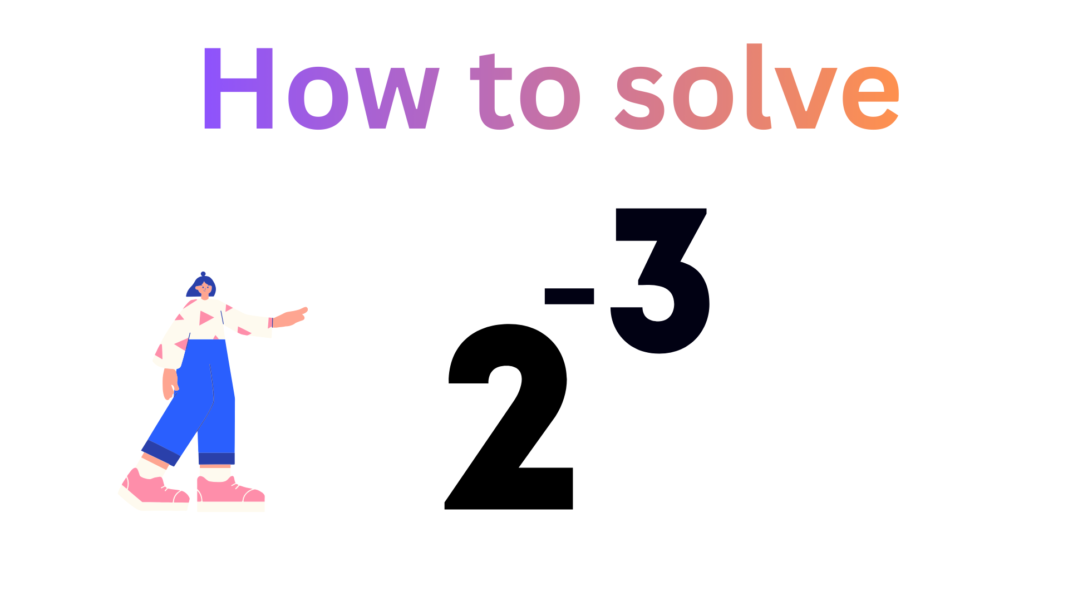
Introduction to Power Notation and 2 Power – 3
Power notation, often referred to as exponential notation, is a mathematical expression involving a base and an exponent. The base represents the number being multiplied, while the exponent indicates how many times to multiply that number by itself. This powerful method of representation is crucial in various mathematical fields, such as algebra, calculus, and number theory, as it simplifies the handling of large numbers and complex calculations.
In this guide, we will focus on understanding the expression 2 raised to the power of -3, or 2-3. When we encounter negative exponents, it is important to recognize that they signify the reciprocal of the base raised to the absolute value of the exponent. Consequently, the expression 2-3 can be transformed into its reciprocal form as follows: 1/(23). This notation signifies that we take the base, 2, raised to a positive exponent of 3, resulting in 23 = 2 × 2 × 2 = 8. Thus, 2-3 = 1/8.
The significance of power notation and negative exponents extends beyond mere computation. They play a crucial role in various applications across science and engineering, such as in calculating decay rates in physics or representing the scale of very small quantities in chemistry, among other fields. Understanding how to handle expressions like 2-3 provides a foundation for grasping more complex mathematical concepts and enhances analytical skills which are applicable in real-world contexts.
Understanding Negative Exponents
Negative exponents represent a fundamental mathematical concept that provides insight into the properties of numbers. To understand negative exponents, it is essential to grasp how they relate to positive exponents. By definition, an expression such as a-n indicates the reciprocal of a raised to the power of n. This can be mathematically expressed as:
a-n = 1 / an
For instance, consider the expression 2-3. By applying the definition of negative exponents, we convert it into:
2-3 = 1 / 23 = 1 / 8
This calculation illustrates how negative exponents simplify the understanding of dividing by powers of a number. The rule of negative exponents not only applies to whole numbers but can be extended to fractions and variables, allowing for a wide range of applicability.
Another illustration can be derived from the base of a fraction. Consider (3/2)-2. Following our established rule, we can rewrite this as:
(3/2)-2 = 1 / (3/2)2 = 1 / (9/4) = 4/9
This further reinforces that negative exponents flip the base and change the sign of the exponent to a positive value. The comprehension of this mathematical property is vital, especially when solving equations that involve both positive and negative exponents or when performing calculations involving exponential functions.
By reinforcing these concepts with ample examples and practice, one can efficiently tackle problems involving negative exponents in various mathematical contexts.
Step-by-Step Solving of 2 Power – 3 Using LaTeX
In this section, we will provide a comprehensive guide on solving the expression 2^{-3} using LaTeX. LaTeX is a powerful typesetting system that is widely used for mathematical and scientific documents. The expression 2^{-3} is a way of denoting the reciprocal of 2 extsuperscript{3}, which is essential in various mathematical computations.
To begin, we represent the expression using LaTeX syntax. The correct LaTeX code for our exponentiation is:
2^{-3}This code effectively places the negative three as an exponent of two, thereby illustrating that we are working with an inverse power. Upon inserting this into a LaTeX document, we utilize the math mode, which can be activated by surrounding our expression with dollar signs:
$2^{-3}$Next, we will evaluate the expression 2^{-3}. This means calculating the value of 1/(2^3). To represent this step in LaTeX, use the following code snippet:
$2^{-3} = rac{1}{2^{3}}$Here, we utilize the rac command to denote the fraction. The resulting calculation involves cubing the base, which leads us to:
2^3 = 8Now, integrating this back into our equation yields:
$2^{-3} = rac{1}{8}$This final step represents how we express the simplification of the original exponent. In summary, this step-by-step guide on solving 2^{-3} using LaTeX has provided essential insights into proper formatting and mathematical representation.
Conclusion and Practical Applications of Exponentiation
In summary, we have thoroughly explored the concept of exponentiation, particularly through the lens of the specific example of 2 raised to the power of -3. This calculation illustrates not only the methodology involved but also highlights some of the broader implications and applications of understanding powers in mathematics. The exponent, whether positive or negative, plays a pivotal role in determining the value of an expression and is foundational in various fields of study.
Understanding powers can unlock insights into complex mathematical operations, including algebraic manipulations and quantitative analysis. For instance, exponentiation is frequently employed in scientific calculations, such as determining exponential growth in populations or decay in radioactive substances. Engineers use these principles to analyze logarithmic scales, enhancing their designs for stability and performance. Moreover, finance professionals often depend on exponentiation when calculating compound interest, affirming its real-world significance.
As we delve further into mathematical studies, grasping the applications of exponentiation serves not only to deepen our comprehension of numerical relationships but also to inspire curiosity in advanced mathematical concepts. Concepts such as logarithms, roots, and exponential functions build on the foundations set by our understanding of straightforward powers. Regardless of the discipline, the ability to manipulate and apply powers effectively can yield valuable solutions and innovative approaches, reinforcing the importance of ongoing exploration in mathematics.