

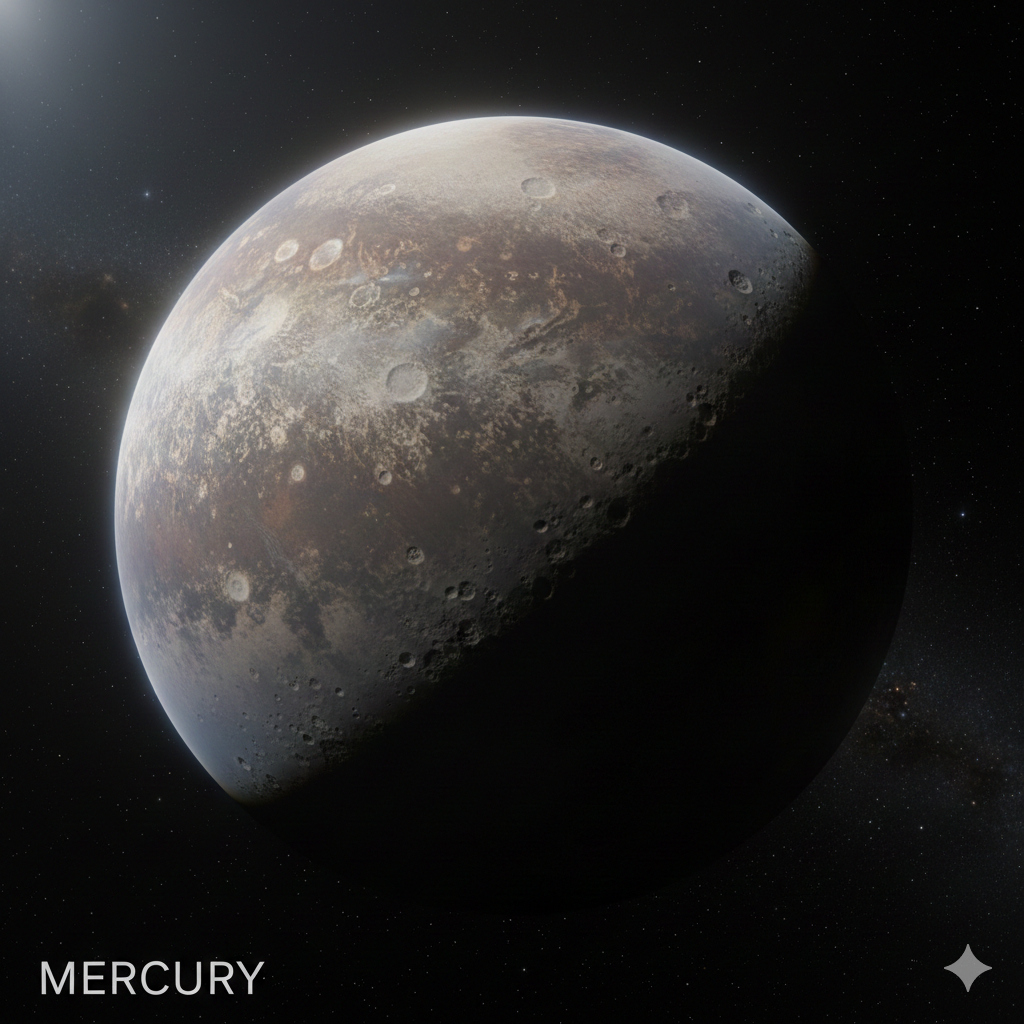
When we look up at the night sky, we often dream of distant worlds. But some of the most fascinating mysteries lie right in our own cosmic backyard. Mercury, the closest planet to the Sun, is a world of extremes—a place where fire meets ice and days last longer than years.
1. A World of Extremes: Temperature and Atmosphere
One might assume that because Mercury is the closest planet to the Sun, it is the hottest. Surprisingly, that title belongs to Venus. However, Mercury experiences the most extreme temperature fluctuations of any planet.
- Scorching Days: During the day, temperatures can skyrocket to a blistering 430°C (800°F)—hot enough to melt lead.
- Freezing Nights: Because Mercury has virtually no atmosphere to trap heat, temperatures plummet to -180°C (-290°F) at night.
The Exosphere
Unlike Earth, Mercury does not have a traditional atmosphere. Instead, it possesses a thin exosphere made up of atoms blasted off the surface by the solar wind and meteoroids. This exosphere is composed mostly of oxygen, sodium, hydrogen, helium, and potassium.
2. Anatomy of a Rocky World
Mercury is a terrestrial planet, meaning it is rocky like Earth, Venus, and Mars. However, its internal structure is unique.
[Image of structure of planet Mercury]
Diagram showing Mercury’s large iron core relative to its mantle and crust.
The Iron Core
The most striking feature of Mercury is its massive metallic core.
- Core Size: The core makes up about 85% of the planet’s radius.
- Composition: It is huge and rich in iron, partly liquid, which generates a global magnetic field—a rarity for such a small planet.
Surface Features
Mercury’s surface looks remarkably like Earth’s Moon. It is heavily cratered, indicating that it has been geologically inactive for billions of years.
- Caloris Basin: One of the largest impact basins in the solar system, spanning about 1,550 km (960 miles).
- “Weird Terrain”: The shockwave from the Caloris impact was so strong it created jumbled, hilly terrain on the exact opposite side of the planet.
High-resolution image of Mercury’s cratered surface.
3. Orbit and Rotation: A Long Day’s Journey
Mercury moves through space with incredible speed, living up to its namesake, the swift messenger of the Roman gods.
- Fastest Orbit: It travels around the Sun faster than any other planet, completing a year in just 88 Earth days.
- Slow Rotation: While its year is short, its day is incredibly long. Mercury rotates very slowly on its axis. A single “day” (one cycle of day and night) on Mercury takes 176 Earth days.
Fun Fact: If you stood on Mercury, the Sun would appear three times larger than it does on Earth, and sunlight would be seven times brighter.
4. Water Ice on a Burning Planet?
It seems impossible, but NASA’s MESSENGER mission confirmed that water ice exists on Mercury. How?
The planet’s axis has almost no tilt (only about 0.03 degrees), meaning the floors of deep craters at the north and south poles never see sunlight. These “permanently shadowed regions” act as cold traps, preserving water ice for billions of years.
5. Missions to Mercury
Because Mercury is so close to the Sun, it is difficult to visit. The Sun’s gravity pulls spacecraft in, requiring massive amounts of fuel to slow down and enter orbit. Only three missions have targeted this elusive world:
- Mariner 10 (1974-1975): The first spacecraft to fly by Mercury, mapping about 45% of the surface.
- MESSENGER (2004-2015): The first to orbit Mercury. It provided valuable data on the planet’s composition, magnetic field, and confirmed the existence of polar ice.
- BepiColombo (Launched 2018): A joint mission between the European Space Agency (ESA) and the Japan Aerospace Exploration Agency (JAXA). It is currently en route and will arrive in late 2025 to study the planet’s magnetosphere and internal structure in unprecedented detail.
Summary: Fast Facts
| Feature | Data |
|---|---|
| Distance from Sun | ~58 million km (36 million miles) |
| Diameter | 4,880 km (3,032 miles) |
| Length of Year | 88 Earth days |
| Length of Day | 59 Earth days (rotation), 176 Earth days (solar cycle) |
| Moons | 0 |
| Rings | 0 |
Conclusion
Mercury is more than just a scorched rock; it is a dynamic world that challenges our understanding of planetary formation. From its massive iron heart to the ice hidden in its eternal shadows, the “Swift Planet” continues to surprise astronomers and space enthusiasts alike.