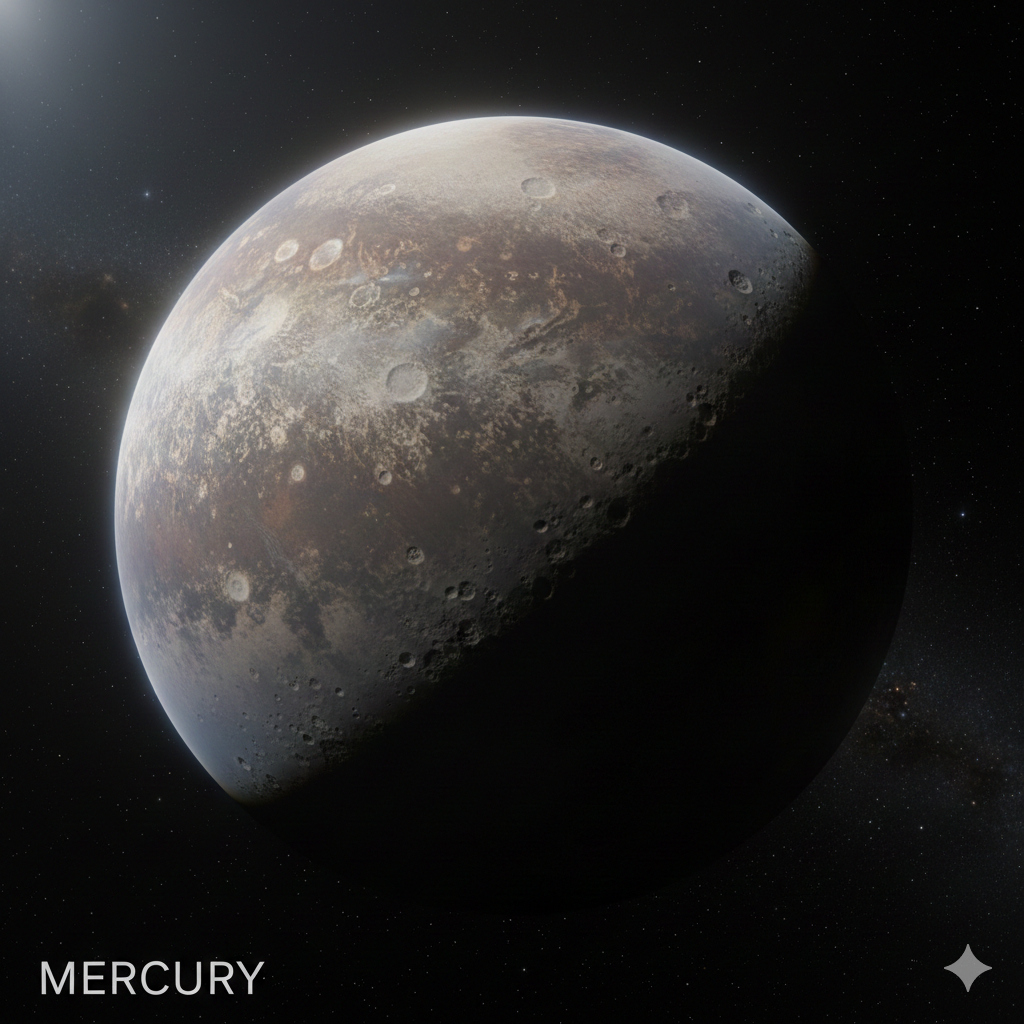
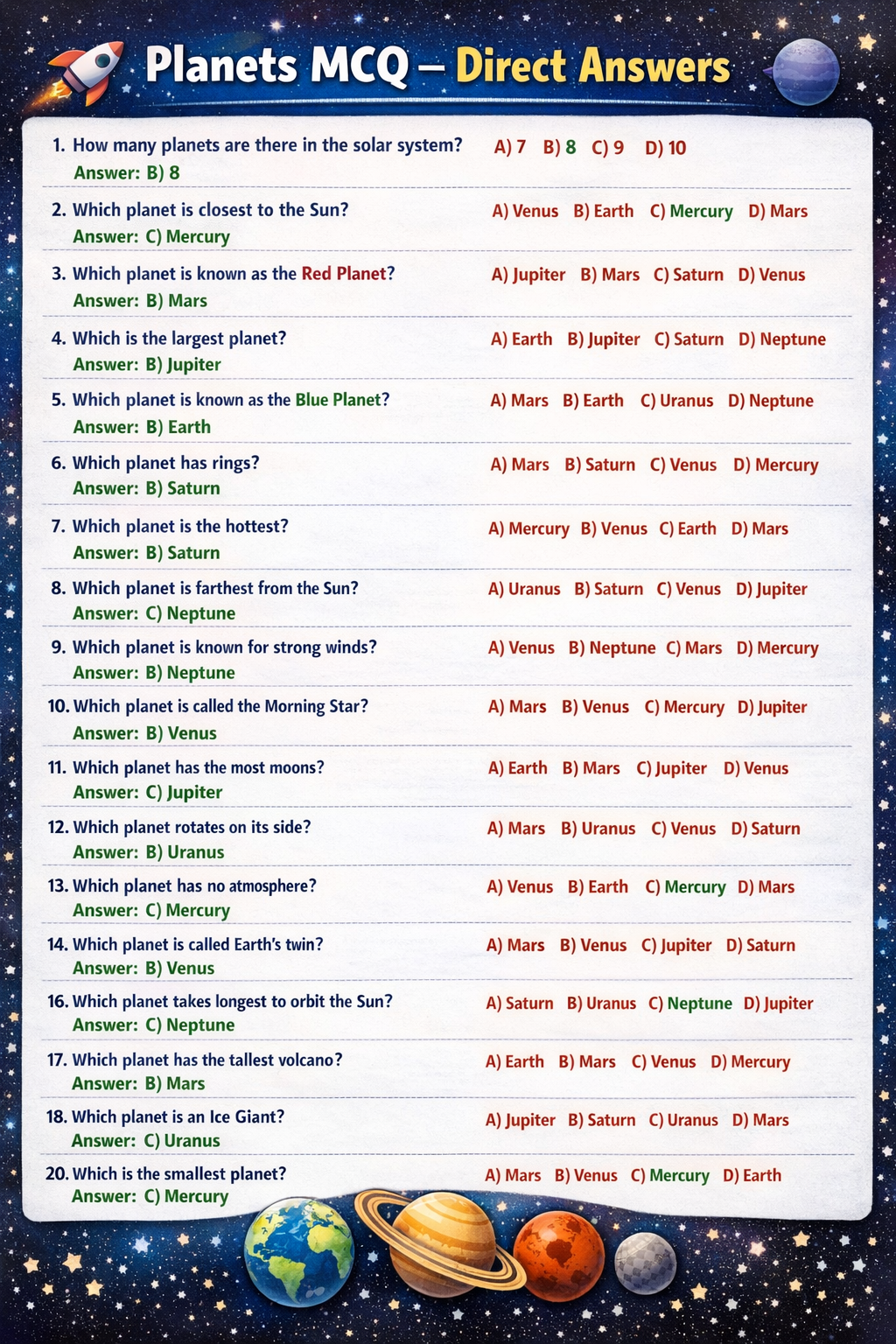
quiz on mercuryquiz on mercury1. Mercury is the closest planet to the Sun. What is its average distance from the Sun?
A) About 58 million km (36 million miles)
B) About 108 million km (67 million miles)
C) About 150 million km (93 million miles)
D) About 228 million km (142 million miles)
2. Why is Mercury’s surface covered with craters?
A) It has frequent volcanic eruptions
B) It lacks a substantial atmosphere to protect it or erode impacts
C) It is constantly bombarded by solar flares
D) It has liquid water that freezes and cracks the surface
3. A “day” on Mercury (one full rotation) is surprisingly long. How long is it?
A) About 24 Earth hours
B) About 59 Earth days
C) About 176 Earth days
D) About 88 Earth days
4. Despite being the closest to the Sun, Mercury is not the hottest planet in our solar system. Which planet holds that title?
A) Mars
B) Venus
C) Jupiter
D) Mercury itself is the hottest
5. What is the primary reason for Mercury’s extreme temperature range between day and night?
A) Its fast rotation speed
B) Its elliptical orbit
C) Its lack of a significant atmosphere to retain heat
D) The composition of its rocky surface
6. Mercury has a very large iron core. What is a leading theory for why?
A) It formed from mostly iron-rich material
B) A giant impact in its early history stripped away much of its outer rocky mantle
C) Solar radiation converted its surface to iron
D) Its magnetic field draws iron from the Sun
7. Which spacecraft provided the first detailed, global mapping of Mercury’s surface in the 2010s?
A) Voyager 2
B) Cassini
C) Mariner 10
D) MESSENGER
8. Mercury’s orbit is the most elliptical (oval-shaped) of all the planets. What unusual event can this create for an observer on Mercury’s surface?
A) The Sun would appear to rise, set, and then rise again in the same day
B) It would experience permanent daylight at the poles
C) It would have two distinct sunsets of different colors
D) The stars would be visible during the day
9. What are the mysterious, radar-reflective patches found at Mercury’s poles believed to be?
A) Lakes of liquid mercury metal
B) Vast fields of metallic asteroid fragments
C) Water ice in permanently shadowed craters
D) Giant geysers of frozen nitrogen
10. How long is a “year” on Mercury (one orbit around the Sun)?
A) 88 Earth days
B) 365 Earth days
C) 12 Earth years
D) 225 Earth days
Answers & Explanations
1. A) About 58 million km (36 million miles)
-
Mercury orbits at an average distance of 0.39 Astronomical Units (AU), which is roughly 58 million km.
2. B) It lacks a substantial atmosphere to protect it or erode impacts
-
With almost no atmosphere, there is no weather (wind, rain) to erode craters, so they remain for billions of years.
3. B) About 59 Earth days
-
Mercury rotates on its axis very slowly. It takes about 59 Earth days to complete one spin.
4. B) Venus
-
Venus has a thick, carbon dioxide atmosphere that creates a runaway greenhouse effect, making it hotter than Mercury on average, despite being farther from the Sun.
5. C) Its lack of a significant atmosphere to retain heat
-
Temperatures can soar to 430°C (800°F) during the day and plunge to -180°C (-290°F) at night because there’s no atmospheric blanket to trap and distribute heat.
6. B) A giant impact in its early history stripped away much of its outer rocky mantle
-
The “Giant Impact Hypothesis” suggests a colossal collision blew away much of Mercury’s early crust and mantle, leaving the large core relative to its size.
7. D) MESSENGER
-
NASA’s MESSENGER (MErcury Surface, Space ENvironment, GEochemistry, and Ranging) orbited Mercury from 2011 to 2015, mapping its entire surface.
8. A) The Sun would appear to rise, set, and then rise again in the same day
-
Due to Mercury’s elliptical orbit and slow rotation, at certain points on its surface, the Sun appears to briefly reverse its path in the sky.
9. C) Water ice in permanently shadowed craters
-
Data from MESSENGER confirmed that deep craters at Mercury’s poles, which are in permanent shadow, contain deposits of water ice.
10. A) 88 Earth days
-
Mercury zips around the Sun in just 88 Earth days, making its year the shortest of all planets.